Special Needs
Why Dental Care Can Be Harder for People With ADHD
 Blende Dental Group
 78
78
Estimated reading time: 8 minutes
Key Takeaways
- ADHD can affect the executive-function skills involved in scheduling appointments, remembering daily oral-care routines, managing time, and following multi-step treatment plans.
- Research suggests that children and adolescents with ADHD may be at increased risk for dental problems such as plaque buildup, tooth decay, and dental injuries, although findings vary among studies.3
- Sensory sensitivities can occur in people with ADHD and may make certain parts of a dental appointment feel particularly uncomfortable or overwhelming.2
- Missed appointments or inconsistent brushing should not automatically be viewed as a lack of concern about oral health. Practical barriers may be playing an important role.
- Helpful accommodations can include reminders, clear instructions, shorter or more predictable appointments, breaks, and individualized approaches to managing anxiety or sensory discomfort.
- For patients who have significant dental anxiety, difficulty tolerating treatment, or more complex special-care needs, sedation or other specialized approaches may sometimes be considered based on the individual patient.
For people with attention-deficit/hyperactivity disorder (ADHD), staying on top of dental care and oral health routines may involve challenges that have little to do with how much they care about their teeth.
ADHD can affect attention, organization, working memory, planning, time management, and the ability to maintain routines.1 Those same executive-function skills are involved in remembering to brush and floss, scheduling dental appointments, arriving on time, following treatment plans, and returning for routine preventative care.
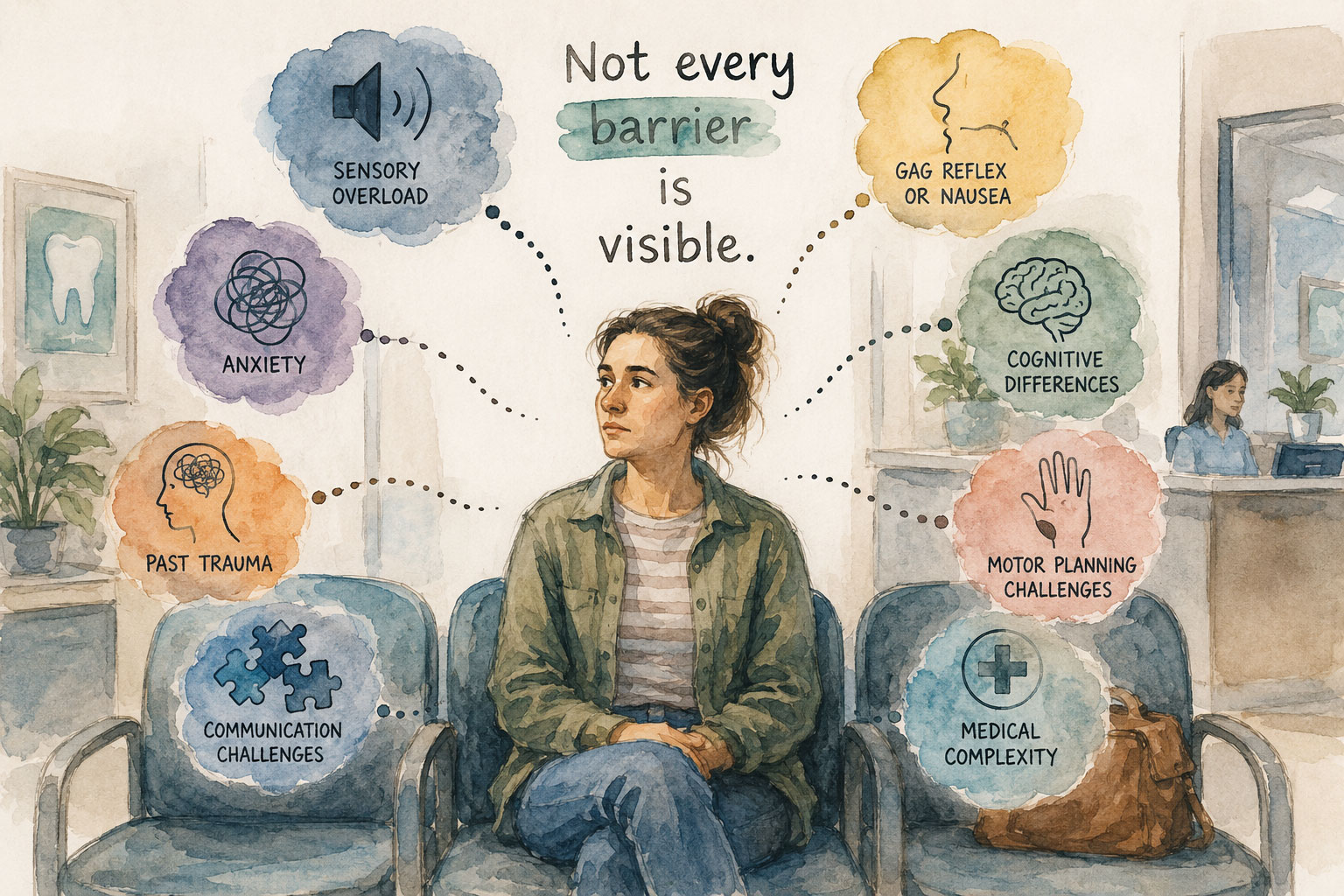
Some people with ADHD also experience increased sensory sensitivity, anxiety, or difficulty tolerating long periods of inactivity.2 In a dental setting, bright lights, unfamiliar sounds, tastes, textures, physical sensations, or simply having to remain still can add another layer of difficulty.
Understanding these barriers can help patients, caregivers, and dental professionals find practical ways to make oral healthcare more manageable.
How ADHD and Executive Function Can Affect Dental Care
Executive functions help us organize, plan, remember what needs to happen next, manage time, and complete tasks.
ADHD can interfere with several of these abilities. The National Institute of Mental Health notes that adults with ADHD may experience disorganization, procrastination, poor time management, difficulty remembering daily tasks, and trouble following through on larger projects.1
Those challenges can show up in dental care in very ordinary ways.
A person may fully intend to call the dentist but repeatedly forget. An appointment six months in the future may disappear from their mental radar until a reminder arrives. A morning brushing routine may work well for several days and then fall apart when a schedule changes. Someone may know that they need to floss but have difficulty consistently starting and completing the task.
These patterns are sometimes described informally as “time blindness,” particularly when someone has difficulty accurately judging how much time has passed or how long a task will take. Whatever terminology is used, difficulties with time management and organization are well documented in ADHD.1
How ADHD Can Affect Brushing, Flossing, and Oral Health
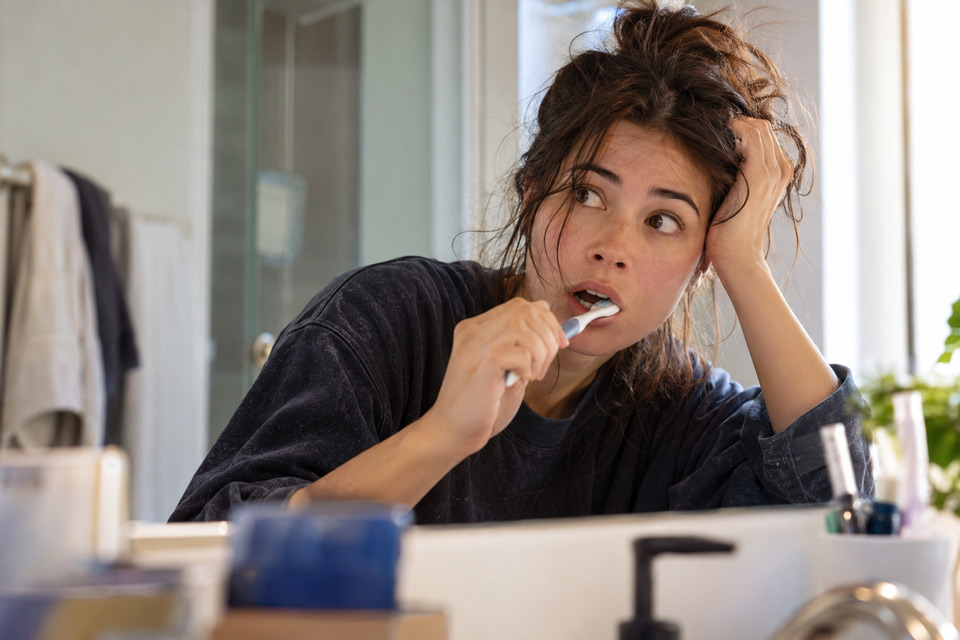
Brushing twice a day sounds simple, but maintaining that habit consistently requires several steps.
You have to remember to do it, stop whatever else you are doing, transition to the bathroom, find the necessary supplies, brush for an adequate amount of time, and repeat the routine every day.
For someone whose ADHD makes routine tasks difficult to initiate or easy to forget, oral hygiene can become inconsistent despite good intentions.
Research supports a possible connection between ADHD and oral-health challenges, including inconsistent oral hygiene, tooth decay, plaque buildup, and dental trauma. A recent systematic review of children and adolescents found trends toward more tooth decay, poorer oral hygiene, and higher rates of dental trauma among young people with ADHD, although the researchers emphasized that the evidence remains variable and that additional research is needed.3
An earlier systematic review and meta-analysis similarly found higher levels of decayed tooth surfaces, plaque, and dental trauma among children with ADHD compared with children without ADHD.4
These findings do not mean that ADHD automatically results in poor oral health. They suggest that some people with ADHD may benefit from additional support in maintaining consistent preventative routines.
Why ADHD Sensory Sensitivities Can Make Dental Visits Harder
A dental office is a highly sensory environment.
There may be bright overhead lights, the sound and vibration of dental instruments, unfamiliar smells, the taste of dental materials, suction, water, gloves touching the mouth, and the physical sensation of someone working in a very sensitive area of the body.
Not everyone with ADHD has sensory sensitivities. However, a recent systematic review and meta-analysis examining more than 5,000 participants found that people with ADHD demonstrated higher levels of several atypical sensory-processing patterns, including sensory sensitivity and sensory avoidance, compared with control groups.2
In dentistry, that can matter.
For example, a patient might find the sound of a dental instrument intensely distracting, struggle with the sensation of suction, dislike certain flavors or textures, or become increasingly uncomfortable after sitting still for an extended period.
Recognizing sensory discomfort as a legitimate part of the experience allows the patient and dental team to explore sensory-aware approaches to dental care that may reduce unnecessary stress.
Dental Anxiety and Avoidance Can Create a Cycle
Dental anxiety and other barriers to dental care can make visits difficult for anyone, whether or not they have ADHD.
When anxiety is combined with executive-function challenges, however, avoidance can become especially easy.
A patient might postpone making an appointment because the task feels unpleasant or complicated. Once the appointment has been delayed, embarrassment about how long it has been may make calling even harder. Dental problems can then progress until pain or another urgent issue finally forces the person to seek care.
Research on dental anxiety more broadly has found an association between dental fear and irregular dental attendance, poorer oral-health behaviors, and the need for additional behavior-management or pharmacological approaches in some patients.5
For that reason, a supportive dental environment matters.
Patients should be able to discuss fear, sensory concerns, difficulty sitting still, previous negative dental experiences, or challenges keeping up with routine care without feeling judged.
Dental Accommodations That May Help People With ADHD
There is no single dental-care strategy that works for every person with ADHD. What helps depends on the individual.
Some patients may benefit from:
- Appointment reminders by text, email, or phone
- Scheduling the next preventative appointment before leaving the office
- Morning appointments, if attention and energy are better earlier in the day
- Clear explanations of what will happen during the visit
- Breaking treatment plans into straightforward, manageable steps
- Written or digital instructions instead of relying only on verbal directions
- Short breaks during longer appointments
- Reducing unnecessary waiting time
- Discussing sensory triggers before treatment begins
- Allowing headphones or other appropriate comfort tools when possible
At home, visible toothbrushes, phone reminders, timers, electric toothbrushes, habit-stacking, or pairing brushing with another established routine may help reduce the amount of memory and planning required.
The goal is not necessarily to try harder. It is often to make the desired behavior easier to remember, start, and repeat.
When Someone Has Avoided Dental Care for a Long Time
People sometimes arrive at a dental office after months or even years without treatment.
For a patient with ADHD, the reasons may include executive-function difficulties, dental fear, sensory discomfort, previous negative experiences, or several of these factors at once.
A nonjudgmental approach is particularly important in these situations.
Blende Dental Group has long emphasized caring for patients whose anxiety, phobias, disabilities, medical circumstances, or other barriers make traditional dental treatment difficult. Its approach to special needs dentistry focuses on individualized care, with accommodations and sedation options considered when appropriate.
The practice has also emphasized listening to patients’ concerns without making them feel ashamed or embarrassed when they have gone without dental care for an extended period.
Is Sedation Dentistry an Option for Patients With ADHD?
Most people with ADHD do not require sedation simply because they have ADHD.
However, when significant anxiety, sensory intolerance, difficulty cooperating with treatment, or other individual circumstances make dentistry especially challenging, different levels of sedation may sometimes be considered.
Blende Dental Group offers several sedation dentistry options, including nitrous oxide, oral conscious sedation, I.V. sedation, and general anesthesia, with the appropriate approach determined according to the individual patient’s circumstances and treatment needs.
Sedation is only one tool. For many patients, straightforward accommodations, communication, predictability, and a dental team that understands their needs may be enough to make care substantially easier.
Dental Care Should Work With the Patient
ADHD can make everyday dental care and seemingly simple healthcare tasks surprisingly complicated.
Remembering an appointment, arriving on time, maintaining a twice-daily brushing routine, tolerating unfamiliar sensations, and returning for preventative care may each require executive-function skills that are particularly demanding for someone with ADHD.
That does not mean good oral health is out of reach.
A dental team that understands ADHD-related barriers to dental care can work with the patient to create a more practical approach. Sometimes that means better reminders. Sometimes it means modifying the appointment experience. For other patients, it may mean addressing significant anxiety or exploring sedation and special-care dentistry.
At Blende Dental Group, the focus is on understanding the individual circumstances that may be standing between a patient and the dental care they need and finding an appropriate path forward. To talk through what would make dental care more manageable for you or someone you care for, contact our San Francisco or New York City office.
Frequently Asked Questions
Can ADHD affect oral health?
ADHD can sometimes make it harder to maintain consistent oral-care routines. Challenges with attention, working memory, organization, time management, and task initiation may affect habits such as brushing, flossing, scheduling dental visits, and following treatment plans. Research has also found associations between ADHD and higher levels of plaque, tooth decay, and dental trauma in some children and adolescents, although findings can vary.3,4
Why can dental appointments be difficult for people with ADHD?
Dental visits may be challenging for some people with ADHD because they can involve several demands at once, including waiting, remaining still, following instructions, managing unfamiliar sensations, and tolerating sounds, lights, tastes, or textures. Executive-function difficulties, sensory sensitivities, and dental anxiety may all contribute to the experience. Clear communication, predictable appointments, breaks, reminders, and other individualized accommodations may help.
What should I tell my dentist if I have ADHD?
It can help to mention anything that makes appointments harder, such as sensory triggers, difficulty sitting still, dental anxiety, or trouble keeping up with routine care. Knowing this in advance lets the dental team plan accommodations like clear explanations, short breaks, less waiting time, and written instructions.
Sources
1 National Institute of Mental Health. “ADHD in Adults: 4 Things to Know.” Describes ADHD-related difficulties with organization, procrastination, time management, planning, remembering daily tasks, and completing projects. NIMH: ADHD in Adults
2 “Sensory Processing in Individuals With Attention-Deficit/Hyperactivity Disorder Compared With Control Populations: A Systematic Review and Meta-Analysis.” Journal of the American Academy of Child & Adolescent Psychiatry, 2025. The review included 30 studies and found greater sensory sensitivity, sensory avoidance, sensory seeking, and other sensory-processing differences among people with ADHD. PubMed: ADHD and sensory processing meta-analysis
3 Chatti M, Chebbi N, Baaziz A. “Attention-deficit hyperactivity disorder and oral health in children and adolescents: a systematic review.” European Archives of Paediatric Dentistry, 2026. PubMed: ADHD and oral health systematic review
4 “Oral Health of Children With Attention Deficit Hyperactivity Disorder: Systematic Review and Meta-Analysis.” Journal of Attention Disorders. The analysis found increased decayed surfaces, plaque scores, and dental-trauma prevalence among children with ADHD. PubMed: Oral health of children with ADHD
5 “The Relationship between Dental Fear and Anxiety, General Anxiety/Fear, Sensory Over-Responsivity, and Oral Health Behaviors and Outcomes: A Conceptual Model.” The review found relationships among dental fear and anxiety, irregular dental attendance, oral-health behaviors, sensory over-responsivity, and dental behavior-management needs. PubMed: Dental anxiety and sensory over-responsivity
Related Articles
Blende Dental Group
8198

Blende Dental Group
22040
Blende Dental Group
33912

Blende Dental Group
42630

Blende Dental Group
44705

Blende Dental Group
72437
Blende Dental Group
73118

Blende Dental Group
104268

Blende Dental Group
126113

Blende Dental Group
168377

Blende Dental Group
176147

Blende Dental Group
182544
Blende Dental Group
194939

Blende Dental Group
214925
Blende Dental Group
226372

Blende Dental Group
469936

Blende Dental Group
564408
Blende Dental Group
582341
Blende Dental Group
570150

Blende Dental Group
569962
Blende Dental Group
445536
Blende Dental Group
468537
Blende Dental Group
469093

Blende Dental Group
468260
Blende Dental Group
470619
Blende Dental Group
479014
Let's brighten
that smile
The when and where are up to you.