
Special Needs
Casey Nez’s Experience: A Patient Story About Dignity and Access
 Blende Dental Group
 48096
48096

When Diane “Casey” Nez sent a letter to Dr. David Blende after her recent visit, she was simply putting into words what she had experienced as his patient.
“It is always a pleasure to see you. You are such a good and kind man that I never worry when I have a toothache or cavity to be filled. Your gentle manner and respect for my feelings make the dental work almost painless.”
“If anyone ever needs a reference, there is no end to the good things I can say about you and your staff,” she wrote.
Casey praises the team’s expertise in diagnosis and treatment and is grateful for how we accommodated her wheelchair and later the gurney she now uses as a resident of a local nursing home.
The letter Casey sent meant so much to us, and we wanted to share more of her story and her experience with dental care. We also wanted to share some of the full and active life she lived before.
A Full Life Before MS
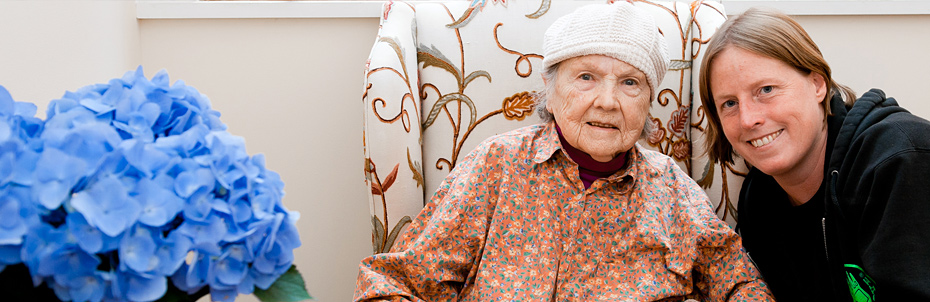
Today, Casey lives in a nursing home and describes herself as paralyzed from the shoulders down. But when asked about her life before the multiple sclerosis progressed, her memories are full of motion, independence, and adventure.
“I rode motorcycles,” she said. “I skied. Ice skated. I had dogs. I had a real life. And then I got sick.”
She had a Harley, two Rottweilers, and was a Technical Director in the fast-paced world of television news. Days were spent at the beach or hiking through the woods with the dogs. She often balanced her love of riding with her love for her dogs.
“Weekends were one day for the dogs, one day for riding,” she said, “It was a great, fun life.”
Over time, multiple sclerosis changed what was possible. What began as mild symptoms progressed from limping, then to a manual wheelchair, then an electric wheelchair, and eventually to a gurney for off-site appointments. For years, she could still move her hand enough to drive her electric chair. When the Covid epidemic meant that she couldn’t ride the wheelchair for a few years, even that little bit of movement was gone. More recently, she began using a wheelchair controlled by her mouth.As her condition changed, so did the difficulty of receiving routine dental care.
When Dental Care Becomes Harder to Access
For patients with complex medical needs or significant mobility limitations, dental care is rarely as simple as making an appointment and sitting in a dental chair.
Transportation can be difficult. Transfers can be difficult or impossible. Standard exam rooms may be too small or equipment may not reach. Even basic positioning can become a barrier.
Casey first found the Blende Dental Group several years ago, a recommendation from a nursing home resident who knew that we made house calls and treated patients with complex access needs. At that time, she was still able to come into the office in her wheelchair.
“They fit me and my extra large Wheelchair in one of their exam rooms,” Casey recalled. “They were able to do all the work while i stayed in that chair.”
By the time she found Dr. Blende she needed four teeth removed and chose to do two at a time. Her memory of that care was simple and clear. It was quick, and the treatment itself was almost painless as was the recovery.
Years later, when she developed a toothache, rather than an expensive crown or complete extraction, Dr. Blende ensured she was able to keep the tooth.
Care That Adapts to the Patient
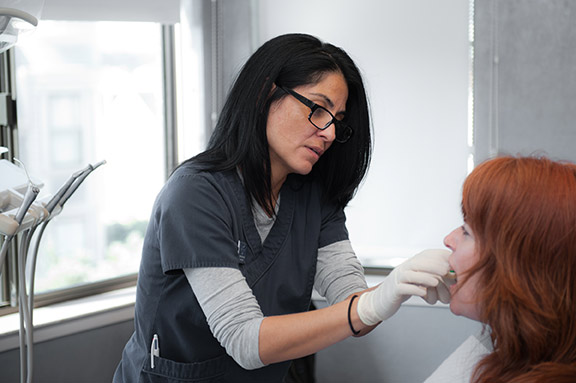
During Casey’s more recent visit, she arrived on a hospital gurney. Rather than treating that as a problem, the team adapted.
We put her in a larger room, and because our team is accustomed to house calls and mobile dentistry, much of the equipment we use is portable.
Casey described the visit as feeling like a regular dental appointment, even though she remained lying down throughout it.
“They did x-rays. They did everything needed,” she said. “The room has a big screen, so they put all my x-rays up.”
That kind of accommodation is easy to overlook when someone has never needed it. But for Casey, it made care possible.
For Casey, the experience was not only about clinical skill. It was also about being seen as a person.
We Never Talk Down to Patients
When asked what stood out most about treatment with Dr. Blende, Casey answered without hesitation.
“That he’s really kind,” she said. “That’s probably the number one thing. And then the fact that he’s really knowledgeable.”
She also described something many patients with disabilities, medical complexity, or long-term care needs will recognize immediately: the importance of being spoken to with respect. Most doctors and healthcare workers talk to the caregiver or support person, but Dr. Blende spoke directly to Casey.
“He doesn’t talk down to me,” Casey said. “Sometimes I’m treated like I’m a child, but he’s kind, friendly, obviously knowledgeable.”
That respect carried through the entire staff and the whole experience, from scheduling to treatment to recovery.
“The whole experience from calling for an appointment to complete recovery could not be better,” she wrote. “You all are a joy to work with.”
Why Stories Like Casey’s Matter
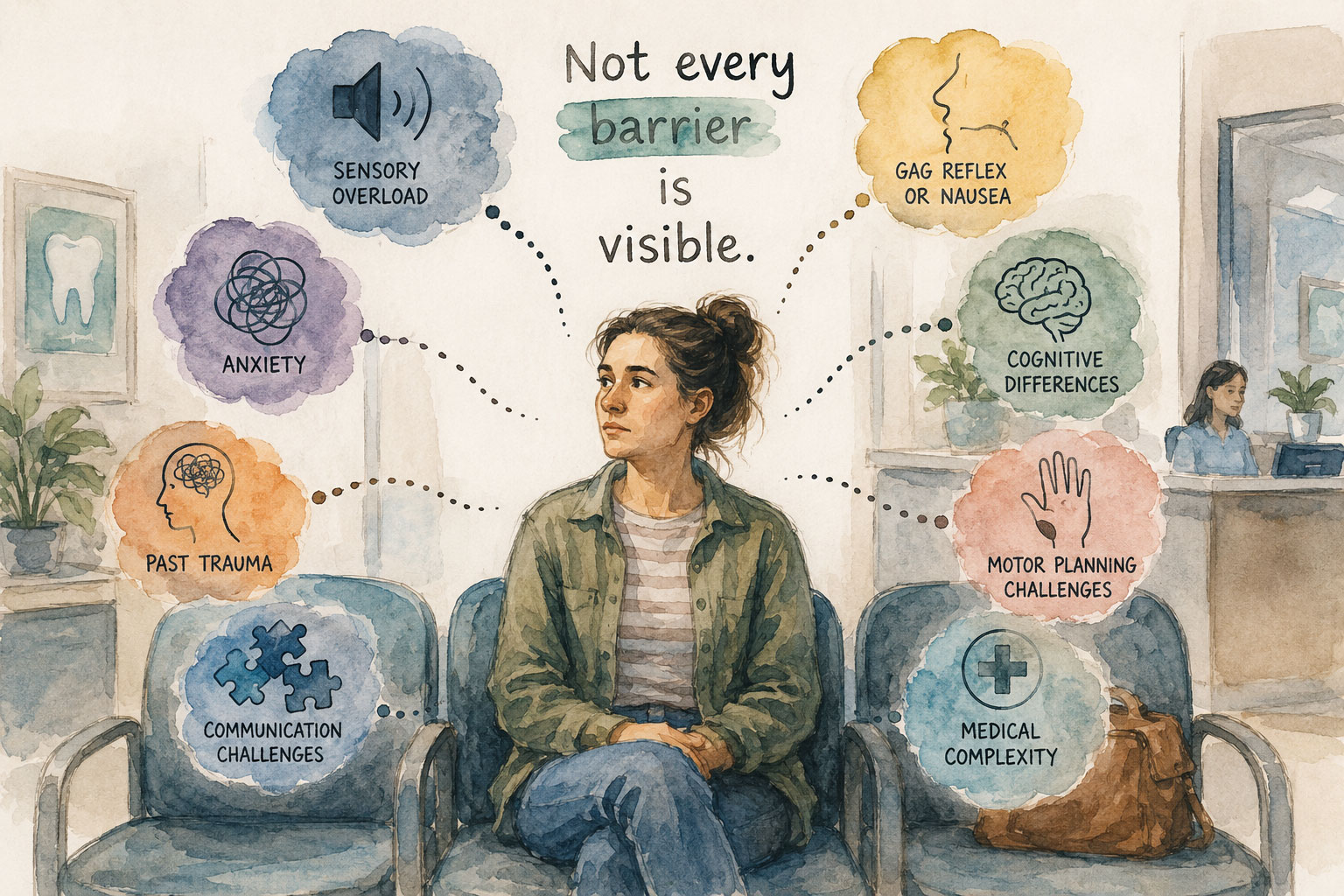
For many people, going to the dentist is an ordinary part of life. For others, it can become nearly impossible because of disability, illness, cognitive changes, medical complexity, anxiety, transportation barriers, or the inability to safely transfer into a dental chair.
Casey’s story is a reminder that those barriers do not mean a person should go without care.
They mean care needs to be designed differently.
At Blende Dental Group, that may mean bringing portable equipment into a different room. It may mean caring for someone in a wheelchair or on a gurney. It may mean coordinating around a nursing home resident’s circumstances.
Most of all, it means approaching each patient with dignity.
Dental Care for Patients Who Need a Different Approach
Casey’s story reflects what Blende Dental Group has always believed: dental care should always adapt to the patient rather than the opposite .
If you or someone you care for has had trouble accessing or receiving dental care because of physical, medical, cognitive, or emotional barriers, the right team can make all the difference. Blende Dental Group is here to help.
About Blende Dental Group
As the founder of the practice, Dr. David Blende built a model of care for patients who often cannot be treated comfortably, safely, or predictably in a traditional dental setting. That standard now extends across the full Blende team, with providers trained to approach complex dental needs with the same level of patience, planning, and respect.
Blende Dental Group is more than a conventional dental office. The practice combines dental expertise with medical coordination, helping patients who may have mobility limitations, complex health conditions, cognitive disabilities, dental anxiety, or difficulty traveling to appointments. The team routinely works with caregivers, care homes, residential facilities, medical providers, and families to determine where and how care can be delivered safely.
That flexibility is central to the practice’s mission. Whether you come to Blende Dental Group or Blende Dental Group comes to you, the goal is to make dental care possible for patients who may otherwise go without it. Care may take place in the office, at home, in a residential care facility, or, when appropriate, in a hospital setting with coordinated support.
Contact Blende Dental Group today to learn more.
Related Articles

Blende Dental Group
2201

Blende Dental Group
6005
Blende Dental Group
27639
Blende Dental Group
39708

Blende Dental Group
50202

Blende Dental Group
78346

Blende Dental Group
110193

Blende Dental Group
132477

Blende Dental Group
174413

Blende Dental Group
182019

Blende Dental Group
188399

Blende Dental Group
200410

Blende Dental Group
220415
Blende Dental Group
231871

Blende Dental Group
573891
Blende Dental Group
591834
Blende Dental Group
579320

Blende Dental Group
579182
Blende Dental Group
476375
Blende Dental Group
476943
Blende Dental Group
476099
Blende Dental Group
478522
Blende Dental Group
487055
Let's brighten
that smile
The when and where are up to you.