
Special Needs
Not Every Barrier to Dental Care Is Visible
 Blende Dental Group
 41342
41342
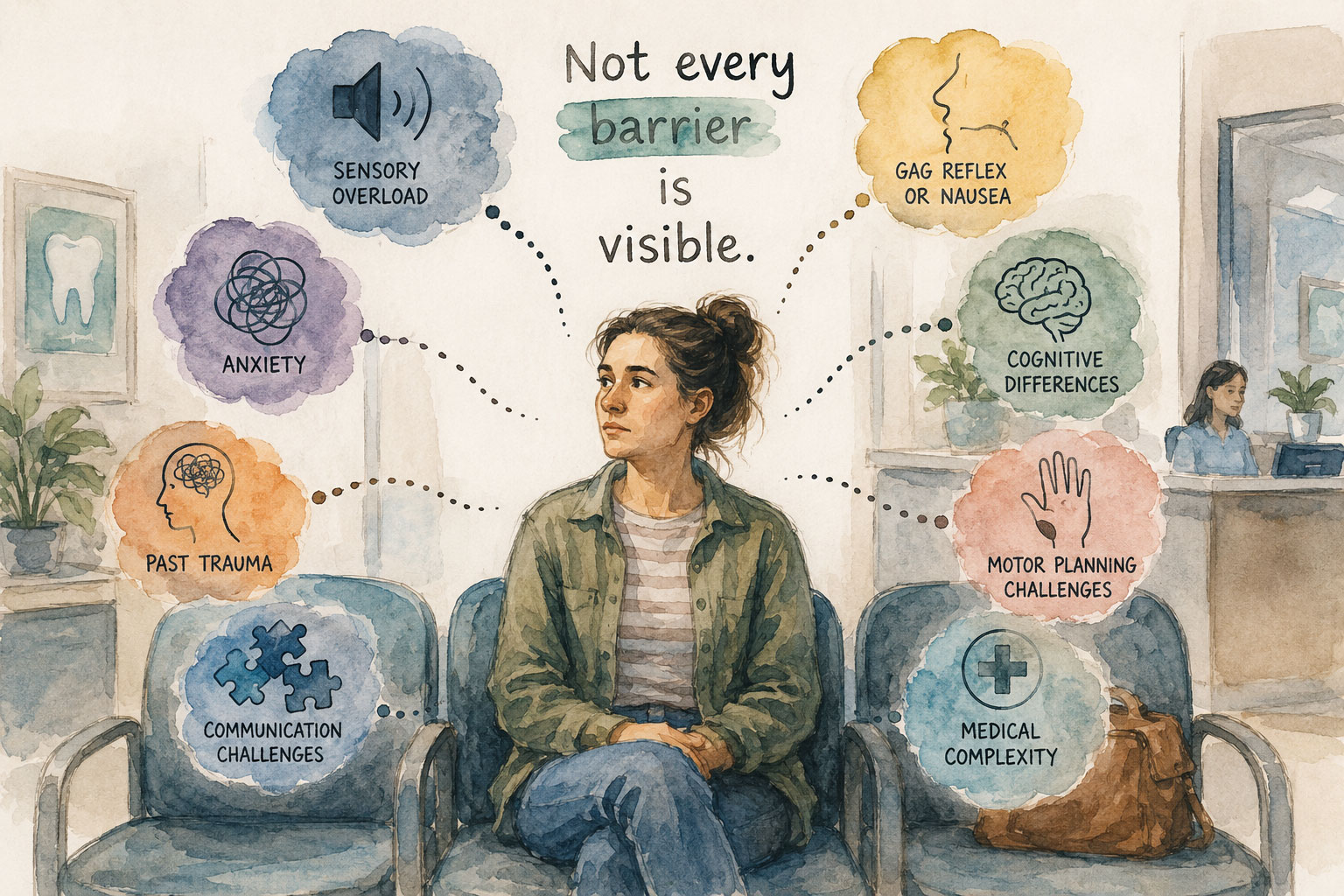
Some disabilities are easy for others to recognize. A wheelchair, a walker, a visible medical device, or a caregiver at someone’s side can signal that a person may need extra support.
But many barriers to dental care are not visible.
A patient may walk into a dental office, sit in the waiting room, and appear physically able to complete a routine appointment. Yet once treatment begins, they may struggle with sensory overload, severe gagging, dental phobia, communication differences, motor planning challenges, trauma responses, cognitive impairment, or medical complexity.
From the outside, these needs can be misunderstood. A patient may be labeled “difficult,” “noncompliant,” “too anxious,” or “unable to cooperate,” when the reality is often much more complex.
The “hidden disabilities” movement has helped bring attention to this gap between appearance and experience. The Centers for Disease Control and Prevention notes that many disabilities, including those related to mental health, autoimmune conditions, neurological conditions, and chronic pain, may be invisible or less apparent to others.1 In dentistry, that idea matters deeply because a patient’s ability to walk into an office does not always mean they can tolerate the sounds, sensations, positioning, communication demands, or physical requirements of dental treatment.
What Is a Hidden Disability?
A hidden disability is a condition or limitation that may not be immediately obvious to other people. It may affect how a person moves, communicates, processes information, tolerates sensory input, manages anxiety, or responds to unfamiliar environments.
The Americans with Disabilities Act recognizes disability broadly, including physical or mental impairments that substantially limit major life activities. These can include speaking, breathing, eating, thinking, concentrating, communicating, walking, standing, seeing, hearing, and other everyday functions.2
In a dental setting, hidden disabilities may include:
- Autism or sensory processing differences
- Severe dental anxiety or phobia
- A strong gag reflex
- Cognitive impairment or dementia
- Chronic pain conditions
- Neurological conditions
- Motor planning challenges
- Complex medical histories
- Trauma related to prior medical or dental experiences
- Communication differences
- Difficulty tolerating touch, sound, taste, smell, or bright lights
A person may not “look disabled,” but the dental environment can still be overwhelming, frightening, painful, confusing, or unsafe without the right accommodations.
Why Dental Care Can Be So Difficult
Dentistry asks a lot from the patient.
A person is expected to lie back, keep their mouth open, remain still, tolerate instruments, accept water and suction, process instructions quickly, manage unexpected sounds and sensations, and trust providers working in one of the most sensitive areas of the body.
For many patients, that is manageable. For others, it can be almost impossible.
A patient with autism may be overwhelmed by the lights, sounds, smells, and touch involved in treatment. A patient with a severe gag reflex may want to cooperate but physically cannot tolerate instruments in the mouth. A person with dental phobia may cancel appointments repeatedly because even thinking about treatment triggers panic. A patient with dementia may become confused or frightened in an unfamiliar office. A medically complex patient may require closer monitoring, physician coordination, or a hospital setting.
The American Academy of Pediatric Dentistry defines special health care needs as physical, developmental, mental, sensory, behavioral, cognitive, or emotional impairments or limiting conditions that may require specialized services, increased awareness, adaptation, and accommodations beyond routine care.3 Although that guidance is written for pediatric dentistry, the same principle applies across the lifespan: some patients need dental care delivered differently.
The Problem With “They Just Won’t Cooperate”
One of the most harmful assumptions in dentistry is that a patient who cannot complete treatment is choosing not to cooperate.
Sometimes, the issue is not willingness. It is capacity.
A patient may want dental care. A caregiver may have spent months trying to arrange an appointment. A referring dentist may have made every reasonable attempt to help. But the patient’s sensory, behavioral, cognitive, emotional, physical, or medical needs may make traditional dental care unworkable.
When these needs are minimized, patients can go years without appropriate care. Dental anxiety is associated with avoidance of dental treatment and can interfere with regular dental care habits and oral-health-related quality of life.4 Over time, delayed care can lead to pain, infection, broken teeth, difficulty eating, worsening oral health, and more complex treatment needs.
The issue is not that these patients do not need dentistry. Often, they need dentistry urgently. The issue is that the system was not built with their needs in mind.
Hidden Barriers Can Become Serious Oral Health Problems
When dental care is inaccessible, small problems can become major ones.
A patient who cannot tolerate a cleaning may develop gum disease. A person who avoids dental visits because of anxiety may not seek care until they are in pain. Someone with a strong gag reflex may put off x-rays or restorative work. A medically fragile patient may need treatment coordinated with physicians, medications, or hospital care before dentistry can be completed safely.
For people with disabilities, access barriers are not limited to the dental chair. The CDC has reported disability-specific disparities in health care access and notes that understanding these differences can help health professionals address barriers and improve health for people with disabilities.5
In dentistry, those barriers may include transportation, office accessibility, communication challenges, insurance limitations, provider discomfort, lack of sedation options, limited hospital access, and a shortage of clinicians trained to treat patients with complex needs.
What Better Dental Access Can Look Like
Better access does not always mean asking the patient to “try harder.” Often, it means adapting the care environment to the patient.
That may include:
- Slower introductions to the office and team
- Clear, calm communication
- Extra time for appointments
- Caregiver involvement when appropriate
- Sensory-aware treatment planning
- Desensitization visits
- Modified positioning
- Shorter appointments
- Sedation options
- Treatment under general anesthesia when needed
- House call dentistry for patients who cannot safely travel
- Hospital-based dentistry for patients with complex medical or behavioral needs
- Collaboration with physicians, specialists, caregivers, and referring dentists
At Blende Dental Group, this is the heart of special care dentistry. The goal is not to force every patient into a traditional dental model. The goal is to understand the barrier, respect the patient’s lived experience, and create a plan that makes care possible.
Blende Dental Group provides individualized care for patients with dental phobias, autism, cognitive and physical disabilities, complex medical conditions, and other special needs. The practice offers in-office care, sedation and sleep dentistry, hospital dentistry, and house call dentistry depending on the patient’s needs, safety considerations, and treatment plan.
Seeing the Patient Behind the Barrier
Hidden disabilities can be especially difficult because patients and families often feel they have to prove that their needs are real.
A patient who looks calm may be internally panicking. A patient who appears physically capable may be fighting chronic pain or neurological symptoms. A child who cannot tolerate a dental exam may be experiencing sensory overload, not misbehavior. An adult who has avoided dentistry for years may be living with shame, fear, trauma, or medical circumstances that have made care feel impossible.
The first step is believing patients when they say something is hard.
The second step is building care around that reality.
Dentistry should not depend on whether a person can mask their disability, suppress their fear, or tolerate an environment that overwhelms them. Patients deserve care that recognizes both visible and invisible barriers.
Not Every Barrier Is Visible, But Every Patient Deserves Care
The hidden disabilities movement reminds us that we cannot judge a person’s needs by appearance alone.
In dentistry, this message is especially important. The patient who looks “fine” in the waiting room may still need extra time, sedation, a different communication style, a caregiver’s support, a home visit, or hospital-based care. Their barriers may not be visible, but they are real.
At Blende Dental Group, we believe dentistry should be possible for patients whose needs are often misunderstood or minimized. Whether the challenge is sensory overload, gagging, fear, communication, mobility, medical complexity, or cognitive impairment, the goal is the same: to remove barriers and help patients receive the care they need with dignity, safety, and compassion.
Contact us today to learn more.
Footnotes
1 Centers for Disease Control and Prevention, “Celebrating the Americans with Disabilities Act: Improving Health for All.” Available at: https://www.cdc.gov/minority-health/features/disability-inclusion-as-a-cornerstone-for-health-equity.html
2 ADA.gov, “Introduction to the Americans with Disabilities Act.” Available at: https://www.ada.gov/topics/intro-to-ada/
3 American Academy of Pediatric Dentistry, “Management of Dental Patients with Special Health Care Needs.” Available at: https://www.aapd.org/globalassets/media/policies_guidelines/bp_shcn.pdf
4 Winkler CH, Bjelopavlovic M, Lehmann KM, Petrowski K, Irmscher L, Berth H. “Impact of Dental Anxiety on Dental Care Routine and Oral-Health-Related Quality of Life in a German Adult Population.” Journal of Clinical Medicine, 2023. Available at: https://pmc.ncbi.nlm.nih.gov/articles/PMC10455740/
5 Centers for Disease Control and Prevention, “Prevalence of Disabilities and Health Care Access by Disability Status and Type Among Adults.” Available at: https://www.cdc.gov/disability-and-health/articles-documents/disabilities-health-care-access.html
Related Articles

Blende Dental Group
6108

Blende Dental Group
7720

Blende Dental Group
13602

Blende Dental Group
29176

Blende Dental Group
49564

Blende Dental Group
51665

Blende Dental Group
80052
Blende Dental Group
79576

Blende Dental Group
111909

Blende Dental Group
134410

Blende Dental Group
176168

Blende Dental Group
183713

Blende Dental Group
190093

Blende Dental Group
201866

Blende Dental Group
221873
Blende Dental Group
233335

Blende Dental Group
480700

Blende Dental Group
577619
Blende Dental Group
595623
Blende Dental Group
582923

Blende Dental Group
582795
Blende Dental Group
455333

Blende Dental Group
479262
Blende Dental Group
479829

Blende Dental Group
478983
Blende Dental Group
481447
Blende Dental Group
490060
Let's brighten
that smile
The when and where are up to you.